

Casino KYC Verification
Know your customer checks are the largest avoidable delay in any withdrawal, and the only part of the process you can finish before you need it.
We earn a commission on links on this page, and it never changes the order. None of these casinos holds a UK Gambling Commission licence, so UK protections including GAMSTOP do not apply to them.
Casino KYC verification is the single biggest cause of a slow first withdrawal, and it is the one delay you can remove entirely by doing it before there is any money waiting. Know your customer checks confirm your identity, your address and that the payment method belongs to you, using photo ID, a document dated inside three months and sometimes a card image. This guide covers what passes, what gets rejected, what source of funds means, and why British licensed sites verify before you deposit.
Casino KYC Verification: What It Is and Why It Exists
KYC stands for know your customer. It is the process of establishing that you are who you say you are, that you are old enough to gamble, and that the payment method belongs to you.
It exists because gambling operators sit under anti money laundering obligations in whatever jurisdiction licenses them. Those obligations are not optional and they are not something an operator can waive to be helpful. A site that skipped them entirely would not keep its licence.
For you, KYC is either a ten minute job on registration day or a three day delay between winning and being paid. It is the same work either way. The only variable is when you do it.
Proof of Identity: Passport or Driving Licence
A clear photograph or scan of a government-issued photo document. In the UK that is normally a passport or a photocard driving licence.
What gets it accepted first time: all four corners visible in frame, no fingers over any part of it, no glare across the photo page, and the document within its expiry date. What gets it rejected is almost always one of those four rather than anything substantive.
The name must match the casino account exactly. An account registered with a shortened first name against a passport showing the full one is enough to fail, and it is a common cause of a rejection that feels inexplicable.
Verification Documents: Proof of Address
A document showing your name and current address, normally dated within the last three months. Utility bills, bank statements and council tax bills are the usual accepted set.
Mobile phone bills are frequently not accepted, which surprises people, because they are considered easier to alter. Neither are screenshots of an online banking summary page in many cases: what is wanted is a statement document rather than a view of an app.
The address must match the one on the account. If you have moved since registering, update the account first and then upload, rather than uploading a document that disagrees with the account and waiting for it to be refused.
Verification Documents: Proof of Payment Method
The third document, and the one people forget exists.
For a card: an image showing the first six and last four digits with the middle numbers covered, and the CVV on the reverse covered entirely. The name on the card must match the account.
For an e-wallet: a screenshot of the account summary showing the account holder name and the account or member ID. Our skrill casino uk and neteller casino uk pages cover the wallet-side requirements in more detail.
For a bank transfer or open banking: usually nothing additional, because the bank has already authenticated you. That is one of the quieter advantages of open banking casino payments.
Electronic Identity Verification via Database Lookup
Not every operator asks for documents, and the ones that do not are not skipping the check.
Many run an electronic verification first: your name, date of birth and address are checked against credit reference and electoral roll data automatically. If the lookup returns a confident match, verification completes silently in seconds and you are never asked for anything.
This is why two people can open accounts at the same casino on the same day and one is asked for documents while the other is not. It is not inconsistency. It is that one of them matched the database and the other did not, usually because of a recent house move, a thin credit file, or a name spelled differently somewhere.
The practical consequence is that a site advertising no document upload is describing electronic checks rather than an absence of checks. Our no verification casinos page takes that apart properly, because the gap between those two things is where a lot of misleading copy lives.
UKGC LCCP Requirements and Age Verification
This matters for understanding the whole market, so it is worth stating precisely.
Under the UK Gambling Commission's Licence Conditions and Codes of Practice, a licensed operator must verify a customer's age and identity before that customer is permitted to deposit or to gamble. Not before a withdrawal. Before play.
That single rule is why a genuinely unverified account cannot exist at a UKGC-licensed casino, and why Pay N Play, which defers identity to the bank login at the point of deposit, has never been licensed in Britain despite working elsewhere in Europe.
The operators compared on this site are licensed offshore and that rule does not bind them, which is why they can let you deposit and play first and ask later. That is a convenience at signup and a delay at the first withdrawal, and it is the same work moved to a worse moment.
Source of Funds and Source of Wealth
A heavier check than KYC and a different question. KYC asks who you are. Source of funds asks where the money you are gambling with came from.
What is typically requested: payslips, bank statements showing the income arriving, a P60, or in some cases a written explanation with supporting evidence. Source of wealth goes further and asks how your overall assets were accumulated, which is rarer and usually reserved for large sums.
It is triggered by amount, by an unusual deposit pattern, or by a risk flag, and it is a regulatory obligation on the operator rather than a stalling tactic. Being asked is not an accusation.
The only thing that shortens it is answering completely and quickly. Partial responses restart the clock, and the most common reason a source of funds check drags for weeks is a customer sending one document at a time.
Enhanced Verification and Due Diligence at Higher Thresholds
Above certain amounts, operators are required to apply enhanced due diligence rather than standard checks. The thresholds vary by jurisdiction and by the operator's own risk policy, and they are not usually published.
In practice this means a larger withdrawal can trigger a level of scrutiny that a smaller one from the same account never would: more documents, a manual review by a person rather than a system, and days rather than hours. It is worth expecting rather than being surprised by, particularly if a single big win is the reason you are withdrawing at all.
Our casino withdrawal limits guide covers the related question of monthly ceilings, which is a different constraint that bites at similar amounts.
What Happens to Your Documents Afterwards
A reasonable question that almost no page about KYC answers.
Operators are required to retain verification records for a period set by their licensing regime, commonly five years after the business relationship ends, because the records are the evidence that the checks were performed. Uploading a passport is not a temporary act and the document does not get deleted when the account closes.
What you can reasonably expect: documents held securely, used for verification and regulatory reporting rather than marketing, and not shared beyond the operator and its verification providers. What you cannot expect at an operator licensed outside the UK is a UK GDPR right to erasure that overrides the retention obligation, or the Information Commissioner's Office as a practical route if something goes wrong.
That is a genuine difference from a UKGC-licensed operator and it is worth weighing before uploading identity documents to a site you do not know much about. It is the same trade this site describes everywhere else, applied to your personal data rather than your money.
Verifying at an Operator You Are Still Testing
There is a tension worth naming. The advice everywhere on this site is to verify on registration day, and verifying means handing a passport and a proof of address to an operator you have not yet tested.
The resolution is to choose the operator carefully first and verify promptly second, rather than spreading documents thinly across many sites to avoid committing to any. One account at an operator you have checked is a smaller exposure than half-finished accounts at six.
A sensible sequence for a site you have not used: read what the cashier publishes per method, deposit a small amount, verify immediately, withdraw promptly, and only then decide whether it is worth more. That test costs the minimum deposit and tells you more than any review, including this one.
What Verification Does Not Protect You From
A verified account is not a guarantee of anything about the operator. It establishes who you are to them. It establishes nothing about them to you.
In particular it creates no recourse. At the operators compared on this site there is no Gambling Commission complaints process and no approved dispute scheme, so a fully verified account with every document approved still leaves you relying on the operator's terms and whatever record you kept if a payout is refused.
What verification does do is remove the single largest avoidable delay from every withdrawal you ever make there, which is worth having on its own terms and is the reason to do it early.
How Long Casino Verification Takes
| Route | Typical time | When it applies |
|---|---|---|
| Electronic database lookup | Seconds | Where your details match cleanly |
| Automated document checking | Minutes to hours | Most modern cashiers |
| Manual document review | Up to 3 working days | Smaller operators, or a failed automated check |
| Source of funds review | Days to weeks | Larger amounts or a risk flag |
All of our recorded approval times on the instant withdrawal casinos board were taken with verification already complete, deliberately. Otherwise we would be timing our own paperwork rather than the operator, and the figures would say nothing useful about the cashier.
Complete Casino KYC Verification on Day One
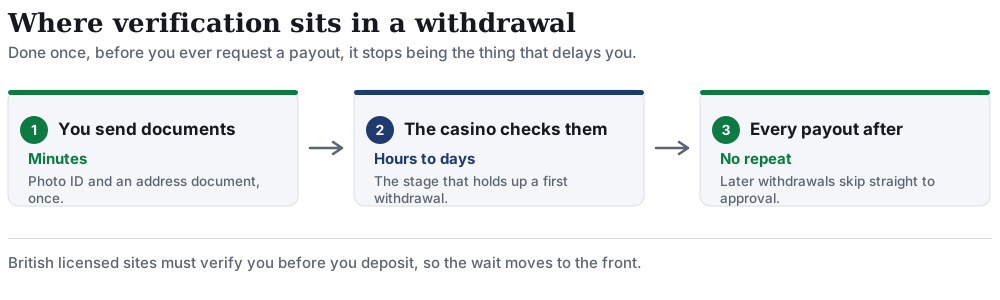
Every operator on this site lets you deposit and play before verification completes, and every one of them stops the first withdrawal until it does. That gap is where nearly all first payout complaints come from.
Uploading documents on the day you register costs ten minutes at a moment when nothing is waiting on it, and turns a three day first payout into a same day one. It is the single highest value action available to a player on this entire site, and it is free.
Getting Verification Right First Time: A Checklist
Most rejections are avoidable and the fixes take seconds. Before uploading anything, run through this.
- Photograph on a flat, dark, plain surface rather than holding the document. It removes shadow, keeps the corners in frame and stops the automated checker cropping it.
- Turn the flash off and use indirect daylight. Glare across a passport photo page is the single most common rejection reason.
- Check all four corners are visible with a margin around them. A checker that cannot see an edge treats the document as cropped.
- Confirm the name matches the account exactly, including middle names and the full rather than shortened first name.
- Check the date on a proof of address is inside the window, normally three months.
- Upload a statement document rather than an app screenshot, which is frequently rejected.
- Send everything at once rather than one item at a time, which restarts the queue each time.
Seven checks, two minutes, and they remove the overwhelming majority of the rejections that turn a same day payout into a three day one.
Casino Verification Documents: What to Do If You Cannot Provide One
Some situations genuinely make the standard set difficult, and they have standard answers.
No utility bill in your name, because you live with family or in shared accommodation. Bank statements are usually accepted and a council tax bill, a tenancy agreement or an HMRC letter often are too. Ask support what the alternative list is rather than uploading the same rejected document twice.
Recently moved, so nothing yet shows the new address. Update the account address first, then supply whatever you have. Most operators will accept a bank statement with a recent date even where the document type would normally need to be older.
No passport or driving licence. A national identity card, a biometric residence permit or a citizen card are commonly accepted, though the list is narrower than for proof of address.
The one situation with no workaround is a payment method in somebody else's name. That will fail, it is not negotiable, and at the operators compared here it can cost you the balance under the terms you accepted.
Where Verification Sits in the Withdrawal Process
Verification is one stage of several, and it is worth seeing it in place rather than in isolation. how casino withdrawals work lays out the whole sequence, and the casino withdrawal guides hub collects the rest.
There is a second connection worth drawing, because it runs the other way. Verifying on registration day shortens the gap between requesting a payout and receiving it, and a shorter gap is less time for a withdrawal to sit somewhere reversible. reverse withdrawal casino explains why that gap is the most expensive thing on a cashier.
The practical reason to care is that an incomplete verification does not announce itself. It shows up as a payout that sits there doing nothing, which is why the second thing pending withdrawal casino tells you to check is whether every document reads approved rather than submitted. Those two pages answer the same question from opposite ends.
Casino KYC Verification FAQs
Can I play before verifying?
At the operators compared here, yes, and you will not be able to withdraw until verification completes. At a UKGC-licensed casino you cannot, because the LCCP requires age and identity verification before a customer deposits or plays.
How long does casino verification take?
Seconds where an electronic database lookup matches you cleanly, minutes to hours with automated document checking, and up to three working days where a person reviews it. A source of funds check runs to days or weeks.
Why does the casino keep rejecting my documents?
Almost always something mundane: a cropped corner, glare across the photo page, a statement older than three months, or a name that does not match the account exactly. Mobile phone bills are often not accepted as proof of address.
Why am I being asked for source of funds?
It is triggered by the amount, an unusual deposit pattern, or a risk flag, and it is a legal obligation on the operator rather than an excuse to delay you. It is not an accusation, and answering completely in one go is the only thing that speeds it up.
Why was I never asked for documents at one casino and asked at another?
The first probably verified you electronically against credit reference and electoral roll data and got a confident match. A recent house move or a thin credit file is usually why the lookup fails and documents get requested instead.
Does verifying early actually make withdrawals faster?
Yes, and it is the largest single difference available to you. It removes one to three working days from a first payout, which is why every recorded time on this site was taken with verification already complete.